LOCAL REALITY FIELD NOTES / ASTRONOMY GEAR
Telescope filters explained: Moon, planetary and nebula filters
Understand what telescope filters do, how lunar, color, broadband and narrowband filters differ, and how to avoid buying the wrong filter for your telescope or target.
PRACTICAL BUYING GUIDE · UPDATED OCTOBER 14, 2026 · NOT A HANDS-ON PRODUCT TEST
Browse telescope filters and accessories ↗
Affiliate disclosure: this retailer link may earn Local Reality a commission at no extra cost to you. Illustrations are for orientation, not a claim that a specific product was tested.
This guide focuses on choosing equipment for a real observing goal, not chasing the biggest specification or the most expensive listing. I have not personally tested every product linked here. Verify exact specifications, compatibility, current stock, shipping, return terms and total cost with the manufacturer or seller before ordering.
What a telescope filter can—and cannot—do
A filter selectively transmits or blocks parts of the incoming light. Depending on its design, it can reduce brightness, alter contrast or transmit wavelengths associated with certain emission nebulae. It cannot increase the telescope's aperture, fix poor focus, stabilize a mount or remove every effect of urban light pollution. The right choice depends on the target, telescope, sky and observer.
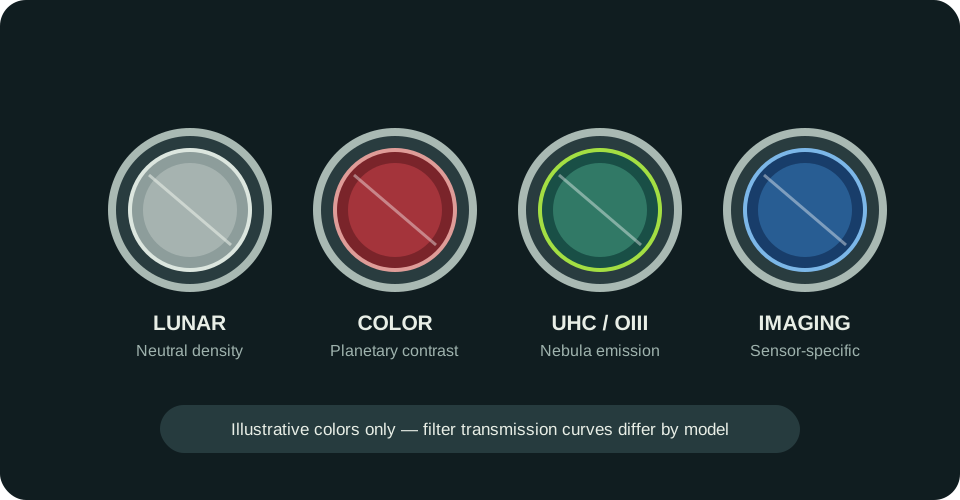
Filter types at a glance
| Filter type | What it does | Good to know |
|---|---|---|
| Moon / neutral-density | Reduces the Moon's brightness for visual comfort. | Often optional; many people observe the Moon without one. It is not a solar filter. |
| Colored planetary | Transmits some colors more than others to alter contrast of selected planetary features. | Effects are subtle and target-dependent. A color filter does not reveal detail absent from the optics or atmosphere. |
| Broadband / light-pollution reduction | Attempts to reduce selected wavelengths associated with some artificial lighting. | Modern LEDs have broad spectra, so results vary; no filter can make a bright urban sky equivalent to a dark site. |
| Nebula / UHC-style | Passes selected emission lines and suppresses other wavelengths. | Can improve contrast on some emission nebulae, depending on passband, aperture and sky conditions; can dim stars and is not ideal for every target. |
| Oxygen-III (OIII) | Passes narrow wavelengths emitted by doubly ionized oxygen in some nebulae. | Specialized for particular nebulae; not a general-purpose filter for galaxies, clusters or planets. |
| Hydrogen-alpha (H-alpha) | In astronomy imaging, can isolate light near the hydrogen-alpha emission line. | Deep-sky imaging filters and dedicated solar H-alpha systems are different products. Never improvise solar viewing with an ordinary filter. |
| Solar filter | Designed specifically to attenuate the Sun's intense light for a defined observing system. | Must be purpose-built for solar observation and installed exactly as directed, normally over the front aperture for white-light telescope viewing. Eyepiece-only solar filters are unsafe. |
Why the target matters more than the label
Emission nebulae can respond to narrowband filters because the gas emits light at particular wavelengths. Galaxies and star clusters are made up largely of stars whose light spans a broad range of wavelengths, so a narrow filter often dims them without creating a comparable contrast gain. A filter that helps one nebula may be a poor choice for another target.
Check the specification, not just the name
Names such as “UHC,” “nebula,” and “light pollution” are not always standardized across brands. Compare the transmission curve, passband width, intended use (visual or imaging), filter diameter and thread. For imaging, also check sensor size, filter holder and camera compatibility. A 1.25-inch filter may not cover every sensor without vignetting; exact results depend on the optical system.
Will a filter fix light pollution?
No. Filters can selectively improve contrast for certain emission nebulae, but they cannot remove the entire bright sky background, and they do not replace a darker site. For many visual targets, dark adaptation, choosing a suitable target and reducing nearby stray light are more useful first steps.
Solar safety is a separate category
Never look at the Sun through binoculars, a telescope or a camera optical finder unless the entire system is equipped with a properly designed solar filter used according to its manufacturer’s instructions. Ordinary Moon filters, colored filters, nebula filters, polarizers and sunglasses are not safe substitutes. Do not use a solar filter that is damaged or does not fit securely. For solar observing, follow a reputable astronomy organization’s dedicated safety guidance.
Compatibility checklist before you order
- Visual observing or imaging?
- Exact target and expected emission line or brightness reduction?
- Filter diameter, thread and adapter compatibility?
- Will the filter be used with a diagonal, reducer, camera or filter wheel?
- Does the manufacturer state the product's actual transmission range?
- For any solar product, is it explicitly designed for the intended solar-observing configuration?
Compare filters and accessories
Use manufacturer specifications rather than category names alone. These retailer links are affiliate links and do not indicate that every filter is suitable for your setup.
Affiliate disclosure: Some retailer links on this site use a referral code. Local Reality may earn a commission from qualifying purchases at no additional cost to you. Affiliate relationships do not guarantee that an item is suitable; check the specifications and your own needs.
Start with binoculars vs. telescope ↗ · Binoculars buying guide ↗ · Telescope eyepieces explained ↗ · Plan a night with the gear you have ↗